Books

Three Books That Every Freemason Will Want to Read

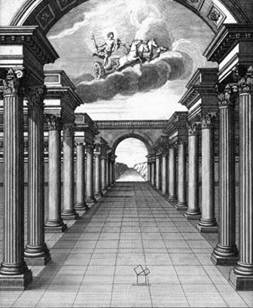
For more than two centuries, Bowring's remarkable paintings have quietly carried a symbolic message waiting to be understood. These books uncover the concealed philosophy behind Freemasonry's ritual, symbolism, and sacred knowledge.

Book Extracts

1) Word Play — What is Freemasonry?

The traditional definition is: A peculiar system of morality, veiled in allegory and illustrated by symbols.

But in modern terms, if peculiar means unique, a system means an organisation, and morality — the heart of Freemasonry — is understood by Rudolf Steiner to be a spiritual reality, then Freemasonry may be more accurately described as:

A unique spiritual organisation veiled in allegory and illustrated by symbols.
2) Metaphor — What is a cowan?

A cowan is a Scottish and northern English term for someone who builds dry-stone walls. The word also serves as a fitting metaphor for the clergy from the Middle Ages to the present: espousers of dry religion without spiritual content.

3) Symbol — What does a Beehive mean?

The spiritual explanation of a beehive originates from the Greek Mystery Schools where a bee represented Man's soul, the hive, heaven, and a field of flowers, Earth. By contemplating this symbol an acolyte learnt the following: Man gathers the results of the lessons he has learned on the physical plane and carries them in his soul across the threshold when he dies.

The lesson for the student to contemplate is not about collecting pollen or making honey; it is about reincarnation.

4) Ritual — What is a square?

In your mind create two imaginary lines, a vertical line, and a horizontal line. Drop the vertical line down from the crown of your head and project the horizontal line back from the root of your nose. Where these two lines meet the pineal gland is found — the bridge between the physical and spiritual world.

The image this makes is an angle of 90 degrees and includes the fourth part of a circle. It is this secret that stands behind the meaning of the Masonic definition of a square: it represents man's head profile, and it expresses his independent ability through his own thinking to be able to connect to the spiritual world.

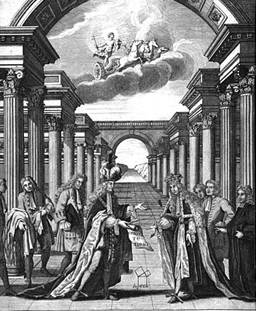
5) Bible Reference — The Frontispiece to Anderson's 1723 Book of Constitutions

To understand this famous Masonic painting, you must ignore the central characters and their entourage in the foreground. The message is found by understanding what is left behind when the nobles and their aides are removed: an arched bridge with a keystone framing the entrance to a dry riverbed, and the 47th Proposition — as Pythagoras unlike Euclid was an initiate. Underneath the proposition is the word Eureka.

When properly understood, the symbols convey Christ's Ascension message to His apostles, whom He called His Brethren — the same term Freemasons use for one another.

The message is concealed in the symbols, painted in allegory, and encoded in the sacred knowledge of Freemasonry.