A painter in Georgian London
Josiah Bowring worked as a portrait painter in London in the late eighteenth and early nineteenth centuries. To Masonic historians he is known chiefly for the tracing boards he produced for lodges: competent, conventional, of their period. Nothing in that public record suggests a man with an esoteric secret.
The exception is a set of three miniature boards, dated 1819 and each no larger than a man's hand. They are painted far too finely, and packed far too densely, for use across a lodge room. They were made to be held and studied.
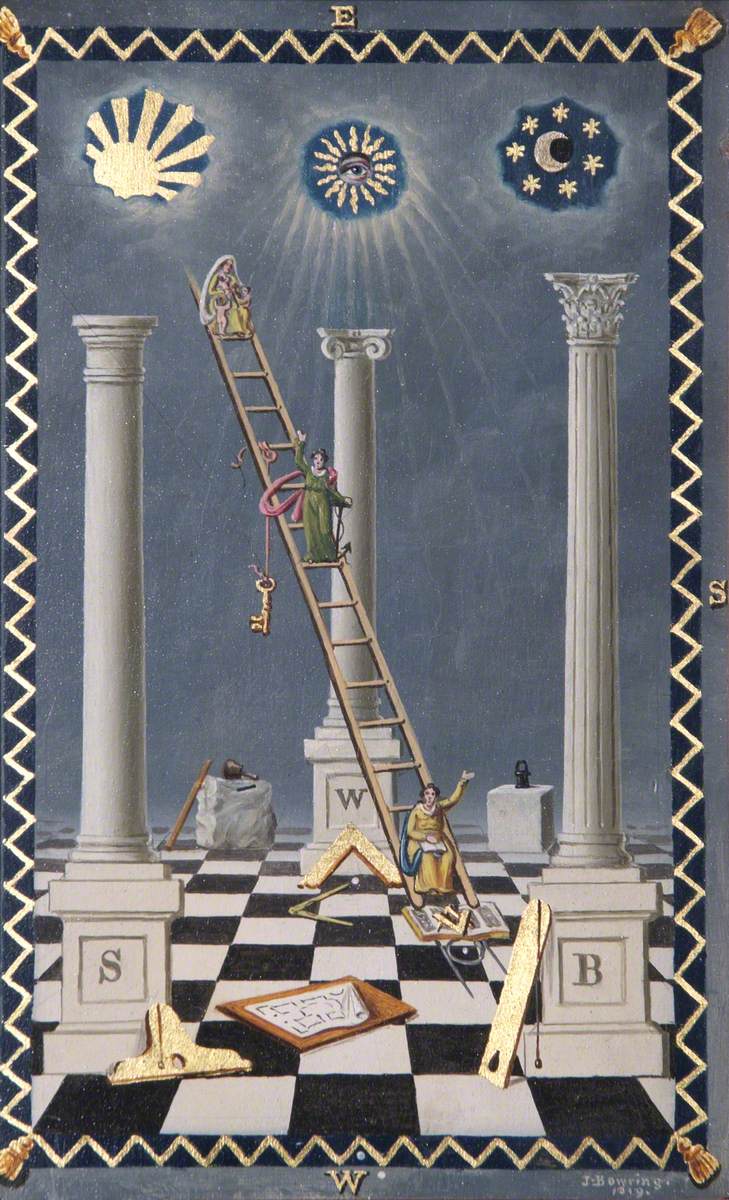
The evidence inside the First Degree board
Fold the First Degree board in half lengthways and its elements combine to state the Rosicrucian maxim: ex Deo nascimur, in Christo morimur, per Spiritum Sanctum reviviscimus — out of God we are born, in Christ we die, through the Holy Spirit we awaken. A device of that kind is not decorative and it is not accidental. It is a signature written in a language only a fellow initiate would be looking for.
That single find carries the weight of the argument. It suggests Bowring was not merely a Mason who painted, but a Rosicrucian — and therefore the first authentic Rosicrucian Master ever to be identified.
The "Invisibles"
The Rosicrucian brotherhood of the seventeenth and eighteenth centuries was known to its contemporaries as the Invisibles: members were bound to leave no public trace, to hold no recognisable office, and to pass their knowledge on inside ordinary work. A painter was well placed to obey that rule. His teaching could be delivered in pigment, hidden in plain sight, and survive long after the man was forgotten.
The same signature appears elsewhere. In the frontispiece to James Anderson's 1723 Book of Constitutions, a five-petalled wild rose — the emblem long associated with the Rosicrucian tradition — sits among figures that otherwise seem to record nothing more than the handover of Masonic office. Its presence suggests that artist too was an Invisible, a guardian of esoteric wisdom.
Why Bowring is worth recovering
If the reading holds, Bowring changes what we can know about Rosicrucianism. Instead of an order documented only through manifestos and rumour, we have a named man, a date, and three objects that carry his doctrine intact. The three boards then read as a single continuous teaching about how human beings reach the spiritual world — a teaching Bowring could not have written down, and so painted instead.