The board as a teaching picture
A tracing board is a painted panel displayed in a lodge while a degree is being worked. It gathers the symbols of that degree — pillars, ladders, tools, heavenly bodies, a chequered pavement — into a single composition, so that the candidate sees the whole lesson at once rather than in fragments. The name comes from the operative mason's practice of tracing a design on a board before the stone was cut. In speculative Freemasonry the design being traced is an inner one.
Boards were usually made large, to be seen from across a room. What makes the three boards discussed on this site unusual is their scale: they are no larger than a man's hand, painted with the care of a miniaturist, and clearly made to be studied closely by one person at a time rather than displayed.
Who painted them
Josiah Bowring, a portrait painter working in London in the early nineteenth century, produced the set in 1819. Bowring's larger boards are known to Masonic historians; the miniature set examined here carries a far denser arrangement of symbols, and the arrangement itself turns out to be the message. Read more in the account of Bowring and the "Invisibles".
The First Degree board — an occult history of the cosmos
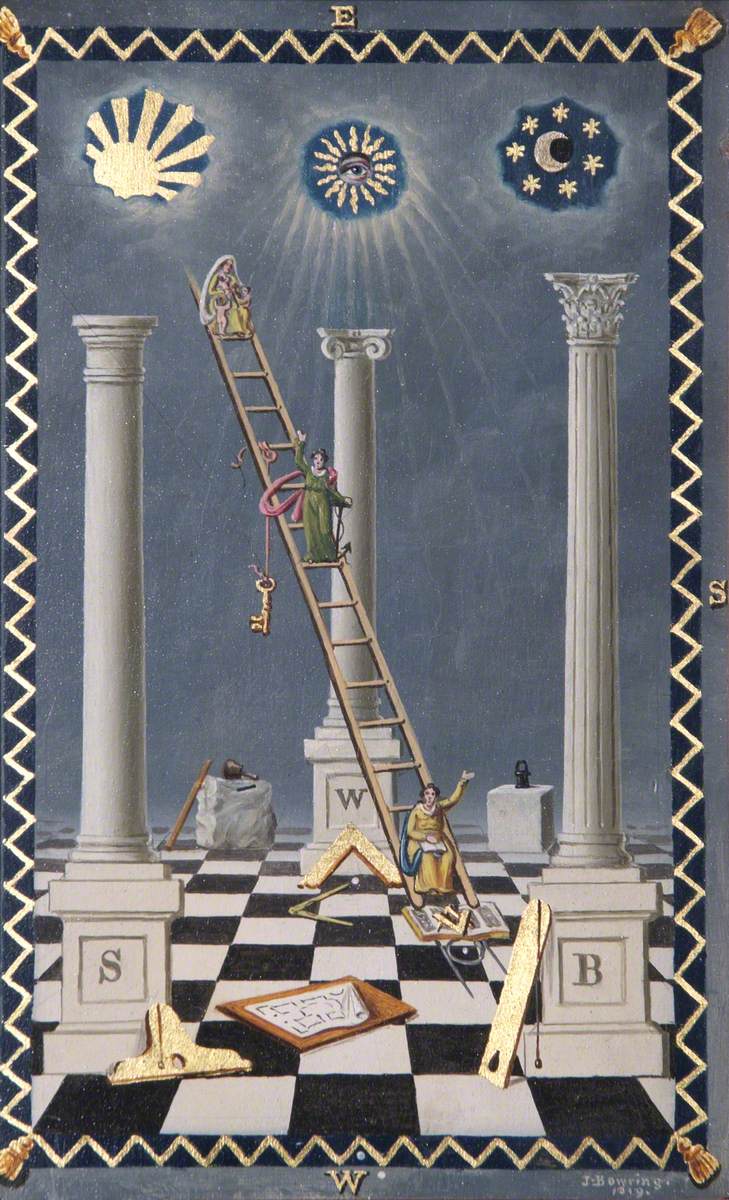
The first board presents a history lesson of the cosmos, the world and mankind, told not in the language of modern materialism but through a spiritual understanding older than our era. The knowledge behind it is a remnant of the ancient Mystery Schools, extinguished by the rise of Roman authority in the fifth century AD; the symbols that carry it were devised much later by the Rosicrucians.
The board's most striking feature only appears when it is folded in half lengthways. The fold brings together elements that spell out the Rosicrucian maxim ex Deo nascimur, in Christo morimur, per Spiritum Sanctum reviviscimus — out of God we are born, in Christ we die, through the Holy Spirit we awaken. A painting that conceals a Rosicrucian creed in its own geometry is not a piece of lodge furniture; it is a statement of allegiance.
The Second Degree board — two ancient paths, superseded
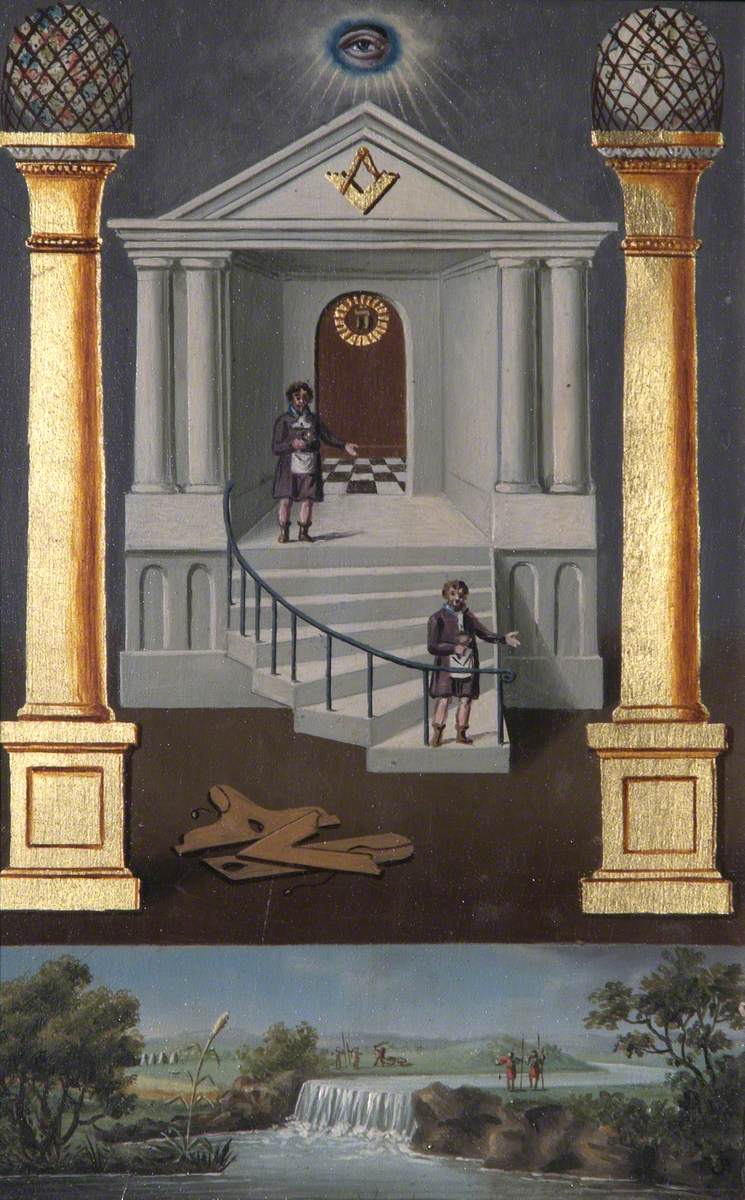
The second board sets out the two great initiation paths of the ancient world — the mystic path and the ecstatic path — which guided seekers toward enlightenment long before the Christian era. In Freemasonry these two are reflected in the First and Second Degrees and stand embodied in the pillars Boaz and Jachin.
Both paths, the board argues, were superseded by a single event: the sacrificial death of Christ, which Masonic imagery renders as "an ear of corn near to a fall of water." That death opens the new path of initiation for the present age, and it is the subject of the Third Degree.
The Third Degree board — the raising of soul consciousness
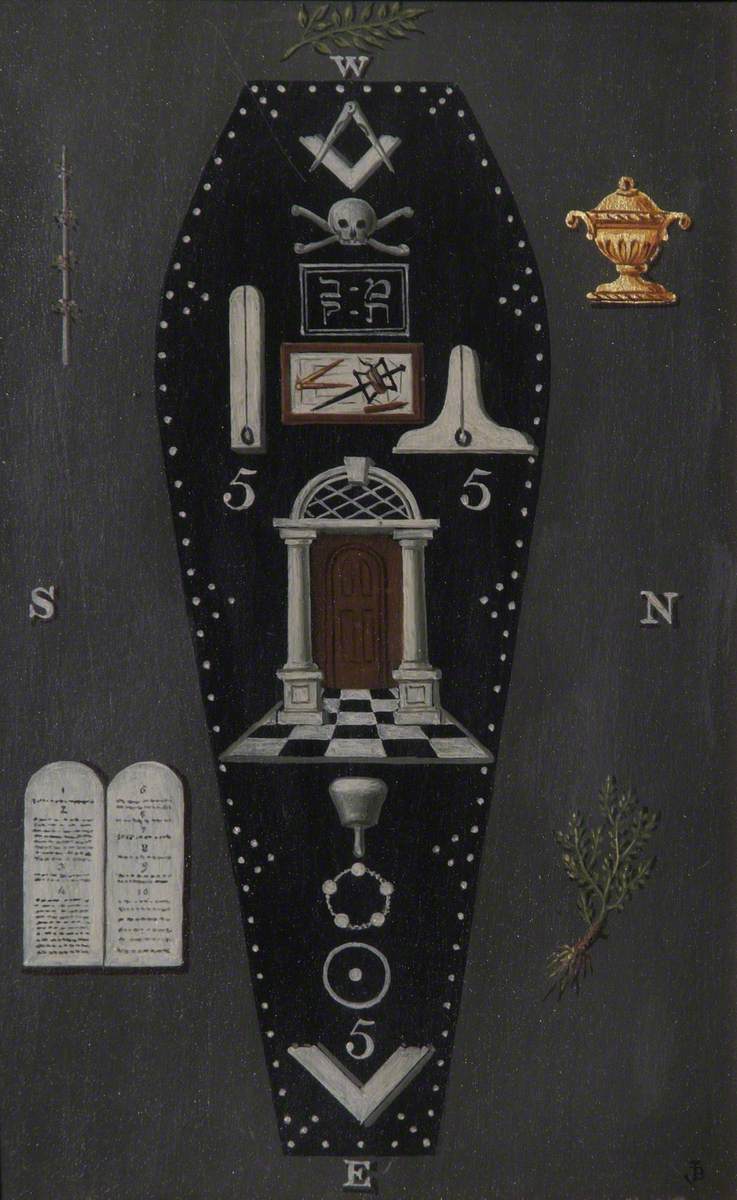
The third board portrays the final stage: the elevation of consciousness and the gateway to full spiritual awakening. Since the Crucifixion, this path — once reserved for a select few inside the Mystery Schools — stands open to anyone who seeks it. It is the road Saint Paul travelled to Damascus. Paul's transformation was immediate and total; a Freemason's is gradual, taken by degree, and ends in the raising of soul consciousness rather than in full awakening.
Why the boards matter
Taken together, the three boards form one continuous argument about how human beings reach the spiritual world, and how that route changed. They are among the few surviving objects that appear to have been made by a Rosicrucian initiate for other initiates, which is why they repay symbol-by- symbol reading rather than a glance.